
Kiss of the Spiderwoman 2025: This is a movie version of a Broadway musical, that I have to admit that I was not aware of. The musical was released on Broadway in May 1993, and it won seven Tony Awards including Best Musical. I had originally thought that this film was a remake of the 1985 movie which starred William Hurt, Sonia Braga and Raul Julia. Hurt won the Best Actor Oscar (as well as BAFTA and Best Actor at Cannes Film Festival) playing the gay Molina. In this musical, actor Tonatiuh plays him. An actor I am not familiar with. Set in Argentina with a ruthless political regime silencing their political foes and inprisoning others regarded as undesireable, the focus is a prison cell. Molina is imprisoned with a political prisoner Valentin Paz, played by Andor‘s Diego Luna. They start out with diametrically opposed attitudes and views of their situation and the circumstances around their imprisonment. One of the ways for these two to break the ice and pass time together is to discuss a film that Molina loves to daydream about.
Molina is transported in his dreams into the film with Jennifer Lopez playing Ingrid (as well as the Spider Woman) who has her own story to pursue with Tonatiuh playing a love interest as well as Luna. They are vying for her affections. The singing begins within this story on film.
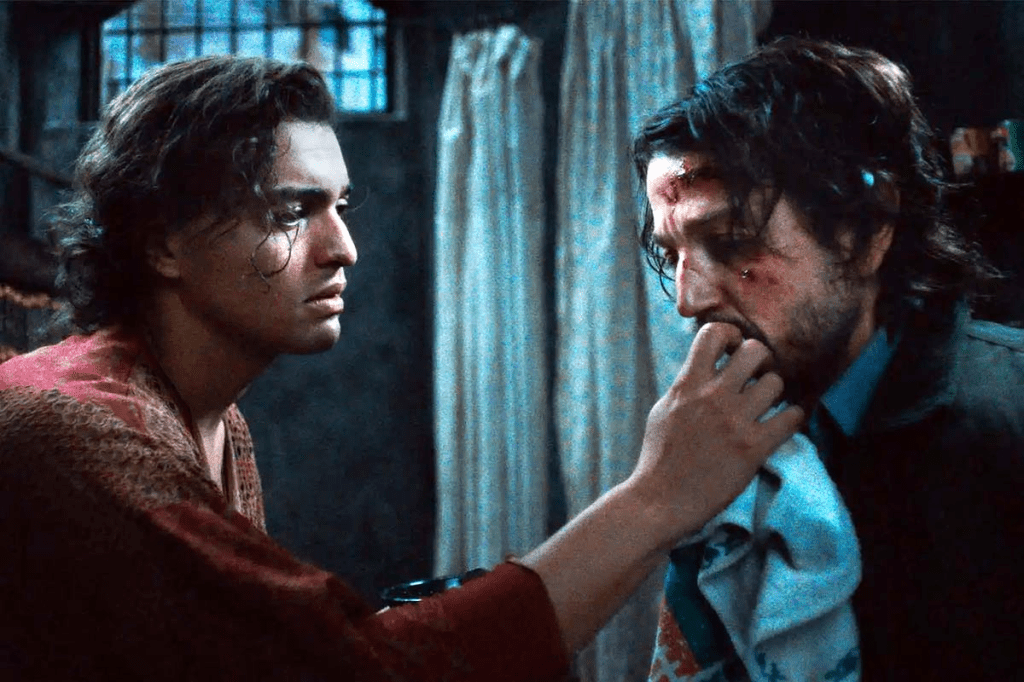
For me, not being familiar with the original music worked against me. I still had visions of the William Hurt film, and it didn’t seem to mesh. I didn’t see how singing worked and was appropriate for a movie with such a dire setting. One wouldn’t expect a musical number with black ties and tails and fancy dress in viewing Papillon, Shawshank Redemption or Midnight Express. Integrating the two prisoners into the musical numbers and scenes with Lopez character builds on the story within the cell. We see the two prisoners connecting, all the while we know that Molina has been blackmailed into assisting the warden in extracting information from Luna. The warden tortures Luna and denies him food and sleep. Molina cares for Luna and nurses him back to health. The story continues. I will say that this is not a typical musical. Yes there are musical numbers, but there is nothing that stood out to me, or that had me humming as it finished. That is the test for me for a quality musical. The film also doesn’t make me want to see the play. Ultimately there is a similar arch for the characters as in the Hurt film, where they learn to appreciate that their lives can be so much more. They grow and develop. In time in Argentina the repressive regime was overthrown and the prisoners were released. Certainly there is a message there about political turmoil and repressing ideas and opposition. In the end, I cannot recommend it as the tone for a prison movie is just off.
The Mission: I decided to revisit this 1986 movie with Jeremy Irons and Robert DeNiro after my travels in South America. An observation for me as I moved about the continent was that we here in North America know so very little about these countries. Yes, we may know about Narcos and Pablo Escobar along with the well known Colombian coffee harvester Juan Valdez, but beyond that we really don’t know about Ecuador or Chile, Peru or Argentina (save for their new leader). That is too bad. This is a massive continent with so many memorable sights and beautiful scenery.
The movie is set in the mid-1700s, where the Jesuit order is looking to spread the gospel of Christ into the indigenous peoples. Jeremy Irons plays Gabriel who decides with a small group of fellow priests to enter into an area of Argentina near Iguazu Falls. The prior priest had been tied to a cross and sent down the river over the falls by the King of those people. Gabriel’s introduction to the indigenous people is through his playing of his oboe. He is young, idealistic, committed and a firm believer in his faith in God. Gabriel came to these people with the idea that God loves them, and he can bring them a better life away from the jungle. I will note that this film from 1986 throughout used the term “indians” to refer to the “indigenous” peoples, of which there are many, which one seeing this may cause a pause. But I digress.
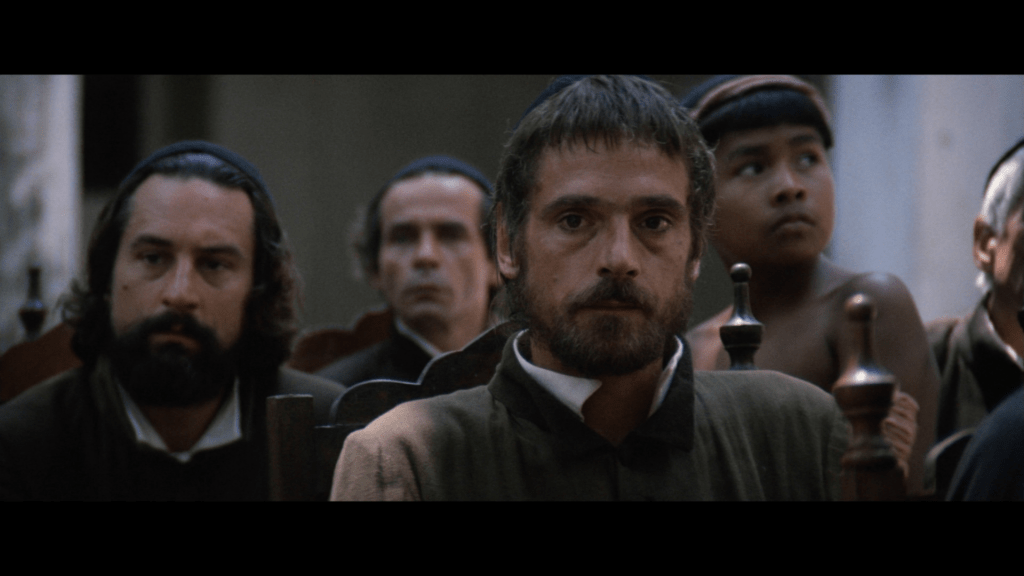
Roderigo Mendoza, played by Robert DeNiro, is a slave trader who is a violent man, quick to anger and sees the worst of humanity, to which he contributes without hesitation. His life changes, however, with an unspeakable act which brings him to seek forgiveness and repentence. Roderigo is brought before Gabriel, and Gabriel expects him to provide absolute obeyance to Gabriel’s word if he was to take him in as a new priest. Roderigo accepts. Roderigo is brought to Gabriel’s mission at the top of the waterfall where he sees the people first hand who he was enslaving. The indigenous people provide him with forgiveness, welcoming him into their community. The mission itself is a haven for the indigenous people (the Guarani) who can avoid enslavement from the territory owned by the Portugese, who run competing businesses, harvesting bananas and other produce.
In the larger political picture, the Jesuits are governed in Spain, and there is an ongoing dispute over territory with Portugal. A treaty is signed between the countries (the Treaty of Madrid) where control is relinquished from Spain (which does not permit slavery) to Portugal who does permit it. The Guarani are surprised by this turn by God and the church and refuse to be permitted to be enslaved by the Portugese. The presiding priest in Spain, even after seeing the magnificent work with these missions, makes a decision to comply with the Act without further consultation with the King of Portugal. The incredible aspect of this is that these foreign religious powers are deciding the fate of people who have lived on this land for centuries. They have no say. The King of the Guarani who welcomed in Gabriel refuses to submit without a fight. Roderigo, despite his pledge to be a man of peace decides that he can assist these people better with his former skills.
The story is a good one and well told. Irons and DeNiro both are very good, and you can see the bond that these two men form over time. Sadly one can see that politics and religion do not mix very well. Man’s interpretation of “God’s will” can be influenced by human pursuits which may fly in the face of love and peace. An idealistic priest like Gabriel can see his faith questioned, with him being forced in obeying the church to walk away from his true beliefs. Gabriel cannot bless Roderigo who chooses to fight and shed the blood of the Portugese with guns, looking to slaughter his community. Throughout the movie, which is beautifully shot, there is the incredible score from Ennio Morricone. His music provides a perfect backdrop with the religious overtones along with the emotion in decisions made on screen. When I originally saw this movie in the theatre as a kid, I liked the soundtrack so much that I bought the cassette. There aren’t that many movies that I have done that. To this day, I find this soundtrack incredibly moving and songs that I still have downloaded on my iPhone. This is a movie that I saw on Plex, a streaming service and I was glad to see it once again. In South America I heard about the Spanish conquering the Inca and taking over places around Cusco. The Spanish destroyed the sacred places for the Inca and put up churches. One society has to impose its will on others. It is a story retold countless times through history. It doesn’t mean that there is less sympathy for those who just want to live their lives, and never wanted to be a part of the politics of the day.

