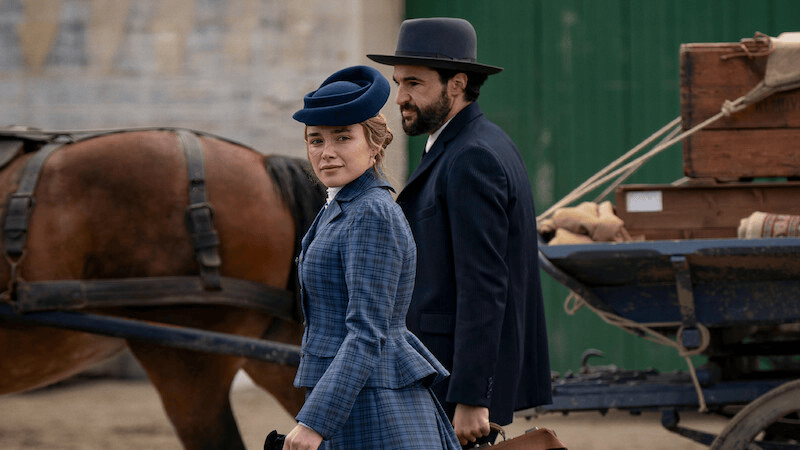
Wicker: This new release is based off the short story called The Wicker Husband by Ursula Wills, which was unknown and unread by me. I came into this with very little knowledge save for a couple of times I had seen a trailer. It stars Olivia Colman, who has had quite a year when you see she was also in Elsinore, coming to a theatre near you in November. It also stars Peter Dinklage (from Game of Thrones), Alex Skarsgard and Elizabeth Debicki (who played Diana in The Crown). Set in a very small rural town, at an unspecified but more medieval time likely in the UK, the simple townspeople are known by their profession. Colman plays the Fish Woman. Dinklage the Basket Weaver, and Debicki is Tailor’s Wife. Skarsgard is the Wicker Man. This is a fable. In this small town, they have very old-fashioned ideas about relationships and marriage. We are shown an earlier marriage ceremony with ordinary townsfolk (the Bottlewasher and his wife) where there is an extremely unusual aspect to the ceremony. In a short scene, we learn plenty about this community. Next we see the Fish Woman, who after taking on her catch walks through town with it and tries to sell it. She is mocked for the way she smells as she clearly doesn’t worry about what others think about her appearance. She has some clever retorts back to those who mock her. The story continues.
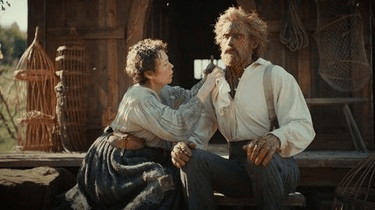
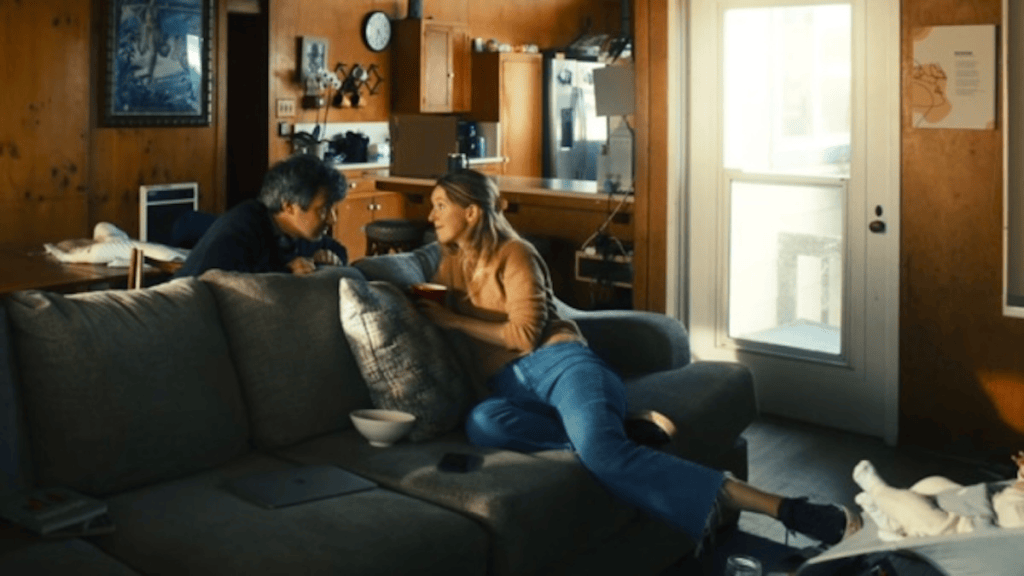
Tired of being mocked and jeered the Fish Woman approaches the talented Basket Weaver to make her a husband. She hands over a few sheckles and walks away after the Basket Weaver states “meet at the church in one month”. Fast forward to that day and she meets her usual new husband. He speaks. He is polite. He is aware of community morals and ensures that he meets them. They are married. Their relationship starts as many pre-arranged marriages likely would. Of course there are challenges brought forward mostly with the skeptic townspeople and their small minds and pettiness.
I really enjoyed this movie. It is a clever story well told. Human nature is explored with all its bullying, jealousy, envy, joy, love and connection as well. This is after all a love story between two unlikely people. One who never looked for love, nor expected for it to come to her door, and the other a manufactured man who may just be everything a woman in those times would be looking for. Even those who are pure of heart and intention can have their world turn upside down by those around them. There are some people who find joy in tearing other people down in order to rise up themselves. I am hard pressed to find a more calculating villain than what is displayed here. It is effectively done. The final act is a Moral of The Story most befitting Tyrion Lannister. There is a very good lesson learned among all the townspeople as it unfolds. This was worth my time and money at the theatre. Does it need to be seen at a theatre? Likely not, and it will be in streaming services soon enough. However, there is always something to be said for having a dedicated couple of hours to focus on the screen.
Bad Apples: This is a new release streaming directed by Jonatan Exler. Set in modern day Britain, Saoirse Ronan stars in this movie as Maria Spencer, as a young teacher of children likely around 12 years old. She is a relatively new teacher and she struggles with her class, primarily because there is a disruptive and unruly young boy Danny who keeps acting out. Parents have complained about her class, and with a limited numner of actions she can actually take she feels as though her hands are tied. Danny ruins an offsite excursion and later shows up late and verbally abuses everyone. Miss Spencer is told that “handling difficult children is part of the job” as there are no further resources that the principal can offer. This is a movie with a good supporting cast with actors that I was generally not familiar with.
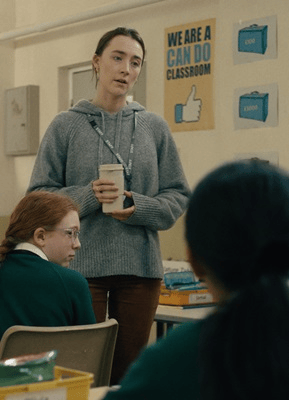
This is a dark comedy, and a reflection into current scholls and education programs. The resources are spread particularly thin, and large class sizes with teachers acting often as glorified baby sitters means that a mischievous student becomes a focal point and others in the class are unable to show their true talents. Miss Spencer ends up in a particularly difficult scenario with young Danny, and needs to take action. Where things go from here show how difficult that matters can get. A number of things are learned and Miss Spencer does her level best to make the most of the situation, including watching her class and her own teaching effectiveness blossom. Further things happen which puts the whole situation in jeopardy or in the very least in a spot where Miss Spencer is particularly vulnerable. In the final act, things occur which were not expected for me. Overall the story reflects a current reality where a teacher is left with limited options to rectify a classroom situation. Parents are left with the unenviable situation where their own child may have their education set back because there isn’t adequate funding to identify and address the troubled student. The student too may have been pushed through a system where no one wishes to address his real needs but instead just push him along to the next unsuspecting teacher. It can leave that young person feeling unloved and unappreciated. Plenty of themes arise with some quality social commentary. At a time when governments seem to want to regard industry and business more favourably than health care and education for those coming up in society, we can see that this is done with long term consequences for us all. Ronan is one of today’s finest actresses as far as I am concerned, and she plays this effectively. We can sympathize with her and her situation. She is a lonely woman with not much going on in her life, and this job is draining her more fully. If our students don’t have any support, and our teachers feel lost, alone and unappreciated then the long term for the society is going to continue to have unresolved problems.
You Can See Everything – Revisited Second Viewing : I went to see this documentary again with my step-father this past week. He had not seen it, and he was vaguely aware of the Holmes story with Theranos. I went back in enthusiastically knowing that having seen the entirety of the documentary and I would be catching more aspects to it because I already knew where the plot went. In this re-watch, I could focus on the performances and how it the movie all came together.
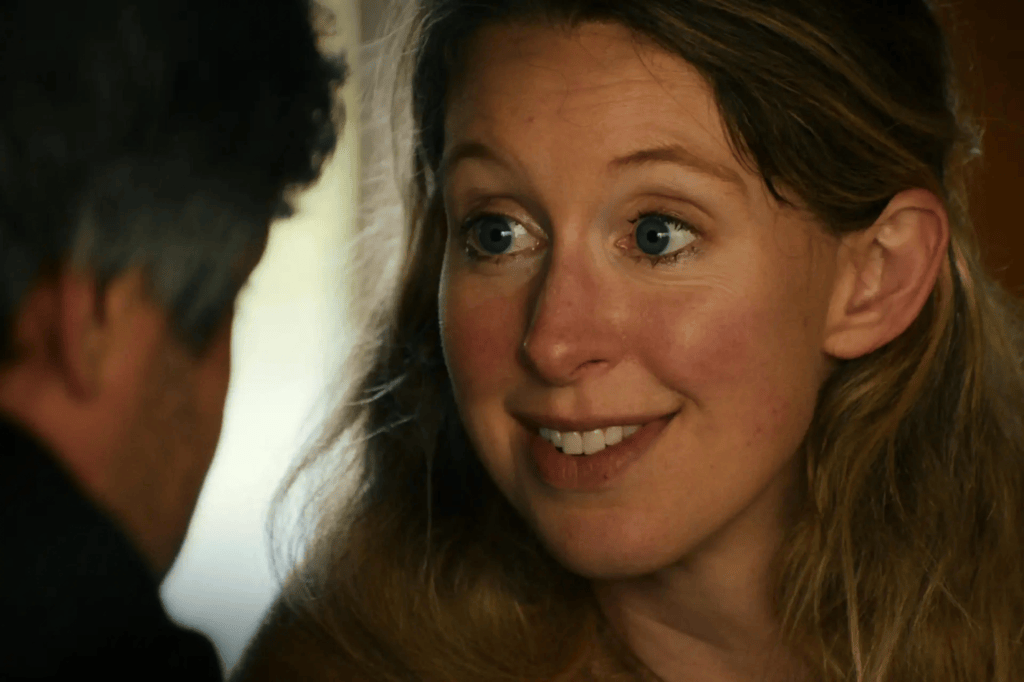
I enjoyed this even more the second time. There are few reasons for this. I think that the editing of the movie is excellent and against the traditional model for documentaries, which follow a linear chronological flow. This movie is set up in two parts. There is first part with documenting Elizabeth Holmes in her rented San Diego flat with her husband Billy and two kids. A delightful young family. We meet her parents as well. We see the 34 days leading up to her incarceration in the Federal Facility in Texas near Austin. The second half of the movie circles back and raises an issue about Billy and shows the discussion about details before the movie even began. It more fully explores Elizabeth herself and what she knew and what she didn’t know. We see more deeply her relationship with Billy and how he acts as he says knowing what she would be thinking. The movie ingeniously leverages a previous particupant in an Elizabeth TV series (The Dropout) to fill in places where filming can’t be done with the actual Elizabeth. Often pure recollection is used to script those moments. Media, interpretation of facts, human recollection of events, perception and how ones mind works were all at play. There is a fascinating discussion with Elizabeth talking about specifications or capabilties of her invention Edison 1.0 for Theranos. She is asked what her definition of a lie is and she responds “knowingly telling something that you believe to be untrue”. Elizabeth talks often about “her truth”. The key words there for me are “you believe” since a person themself may believe something, but that can sometimes be proven to be false. People can be wrong and mistaken. Elizabeth maintains right up until incarceration that she has done nothing wrong. That seems so perplexing because it was proven in Court that the Edison 1.0 device was not capable of doing the tests that it claimed. The harm of course was that real people went to local drug store labs to have blood work done and it was incorrect. The test results were wrong. So the technological wonder wasn’t ready for primetime. When you deal with people’s health the “fake it until you make it” attitude of Silicon Valley and Steve Jobs just is too dangerous. It isn’t data on a floppy disk that is at risk. It can be a cancer diagnosis. Further Elizabeth’s choice of romantic partner is put into question, and whether she chooses wisely between Suni at Theranos and now Billy. The whole story of how Billy and Elizabeth met was an interesting one. Is she someone who has followed blindly men to her detriment, or is she in lockstep with these men and one of greatest manipulators of our time? The audience gets to choose for themselves. Nathan Fielder is to be commended for bringing forth a new way to see a documentary and effectively telling a compelling story. This is worth your time to see. Some background could very well be useful.